Rethinking How We Learn a Language
Rethinking How We Learn a Language
Have you ever started something with full motivation… only to slowly stop without realizing when it happened — or told yourself “I’ll continue tomorrow”… and then didn’t?
What if the problem isn’t motivation — but the experience itself?
Have you ever started something with full motivation… only to slowly stop without realizing when it happened — or told yourself “I’ll continue tomorrow”… and then didn’t?
What if the problem isn’t motivation — but the experience itself?
Sit back and relax as you watch through this short video before we deep dive!
Sit back and relax as you watch through this short video before we deep dive!
Learning doesn’t usually fail because people lack motivation. It breaks somewhere in between — when progress feels unclear, effort feels repetitive, or showing up starts to feel like a task instead of momentum. This is something that shows up clearly when it comes to learning a new language — something I’ve experienced myself.
This project explores how a learning experience can be designed to support consistency, not just completion —by making progress feel visible, practice feel intentional, and effort feel worth returning to.
This project explores how a learning experience can be designed to support consistency, not just completion - by making progress feel visible, practice feel intentional, and effort feel worth returning to.

Why Consistency breaks?
Most language learning experiences fall into two extremes:
Over-structured — rigid, slow, and feels like school
Over-gamified — engaging, but shallow and directionless
Why Consistency breaks?
Most language learning experiences fall into two extremes:
Over-structured — rigid, slow, and feels like school
Over-gamified — engaging, but shallow and directionless
Neither supports long-term consistency.
Learning doesn’t usually fail at the start — it breaks somewhere in between. Not because users lack motivation, but because continuing starts to feel like effort, the progress feels unclear and practice feels repetitive
The problem isn’t starting — it’s continuing.
Learning doesn’t usually fail at the start — it breaks somewhere in between. Not because users lack motivation, but because continuing starts to feel like effort, the progress feels unclear and practice feels repetitive
The problem isn’t starting — it’s continuing.
The Shift in Thinking
The Shift in Thinking
When someone opens a language learning app, they’re usually not exploring. They’re returning — to continue something they’ve already started. This led to a shift in how I approached the problem.
Instead of asking: “How do I organize the course?”
I reframed it to: “How do I help users continue without thinking?”
When someone opens a language learning app, they’re usually not exploring. They’re returning — to continue something they’ve already started. This led to a shift in how I approached the problem.
Instead of asking: “How do I organize the course?”
I reframed it to: “How do I help users continue without thinking?”
What existing products get right
What existing products get right
While studying existing products, I noticed that strong learning experiences rely on:
Clear structure that guides progression
Lightweight interactions that make daily usage effortless
The challenge wasn’t creating either — but bringing both together seamlessly.
While studying existing products, I noticed that strong learning experiences rely on:
Clear structure that guides progression
Lightweight interactions that make daily usage effortless
The challenge wasn’t creating either — but bringing both together seamlessly.
Designing for consistency
Designing for consistency
To address this, I designed a system focused on supporting consistency throughout the learning journey.
To address this, I designed a system focused on supporting consistency throughout the learning journey.
This approach is built on 3 key ideas:
This approach is built on 3 key ideas:
Reducing friction to start / resume
Reducing friction to start / resume
Helping users quickly continue learning without needing to think, decide, or re-orient themselves each time they return.
Helping users quickly continue learning without needing to think, decide, or re-orient themselves each time they return.
Enabling focused improvement
Enabling focused improvement
Shifting from passive exposure to intentional practice by allowing users to isolate and improve specific skills.
Shifting from passive exposure to intentional practice by allowing users to isolate and improve specific skills.
Reinforcing daily return
Reinforcing daily return
Creating lightweight motivation loops that encourage users to come back — not through pressure, but through clarity, progress, and rhythm.
Creating lightweight motivation loops that encourage users to come back — not through pressure, but through clarity, progress, and rhythm.
Let’s look at how these play out in the product, one by one:
Let’s look at how these play out in the product, one by one:
Reduce friction to start
Reduce friction to start
When users open a language learning app, they’re usually not exploring. They’re returning to continue something they’ve already started.
This changes the core question from — “How do I organize the course?”
to — “How do I help users continue without thinking?”
When users open a language learning app, they’re usually not exploring. They’re returning to continue something they’ve already started.
This changes the core question from — “How do I organize the course?”
to — “How do I help users continue without thinking?”
A resume-first experience - The approach
A resume-first experience - The approach
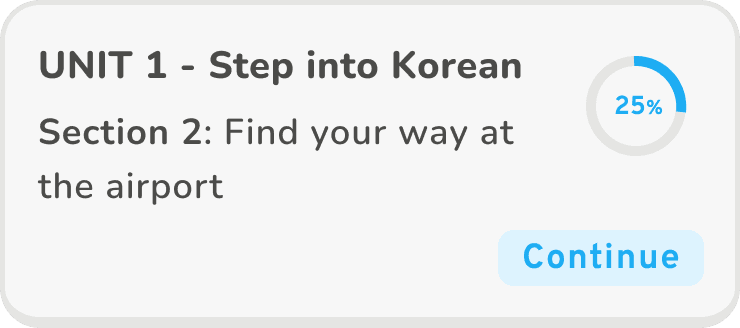
Instead of designing a traditional course catalog, I designed a resume-first learning experience. The interface prioritizes immediate continuation, while still allowing users to explore the structure when needed.
A hybrid interaction model was used, which balances speed with control, without forcing users into either.
Instead of designing a traditional course catalog, I designed a resume-first learning experience. The interface prioritizes immediate continuation, while still allowing users to explore the structure when needed.
A hybrid interaction model was used, which balances speed with control, without forcing users into either.


Quick continue for instant resumption
Quick continue for instant resumption
Flexible navigation for exploration
Flexible navigation for exploration
The “Continue” button follows a resume-first approach, allowing users to pick up exactly where they left off.
The “Continue” button follows a resume-first approach, allowing users to pick up exactly where they left off.
Flexible navigation allows users to explore the full unit or upcoming sections by clicking on the unit card, which opens a detailed breakdown of the content.
Flexible navigation allows users to explore the full unit or upcoming sections by clicking on the unit card, which opens a detailed breakdown of the content.
Section titles clearly indicate what the user is learning in each part of the course.
Section titles clearly indicate what the user is learning in each part of the course.
Progress is shown to reflect how much the user has completed, and is presented as a percentage for easier understanding.
Progress is shown to reflect how much the user has completed, and is presented as a percentage for easier understanding.
Clear sense of progression
Clear sense of progression
Clear unit & section titles for quick understanding
Clear unit & section titles for quick understanding
Trade - offs
Trade - offs
Detailed curriculum visibility was reduced on the home screen, because daily users don’t browse — they continue. Exploration remains available, but it isn’t forced. To keep the experience lightweight, I intentionally removed:
Over-detailed previews
Cluttered progress indicators
Extra navigation steps
Detailed curriculum visibility was reduced on the home screen, because daily users don’t browse — they continue. Exploration remains available, but it isn’t forced. To keep the experience lightweight, I intentionally removed:
Over-detailed previews
Cluttered progress indicators
Extra navigation steps
Enable focused improvement
Enable focused improvement
While the course provides structured progression, it doesn’t always allow users to focus on specific skills. Practice was designed as a separate system — structured around core language skills, allowing users to choose how they want to practice — not just what they want to practice.
While the course provides structured progression, it doesn’t always allow users to focus on specific skills. Practice was designed as a separate system — structured around core language skills, allowing users to choose how they want to practice — not just what they want to practice.

The separation from the course
The course builds exposure.
The course builds exposure.
In the course, users move through mixed activities — reading, listening, speaking, and selecting. This builds familiarity, but doesn’t allow deep focus on any one skill.
In the course, users move through mixed activities — reading, listening, speaking, and selecting. This builds familiarity, but doesn’t allow deep focus on any one skill.
Practice builds confidence.
Practice builds confidence.
Practice changes this by isolating skills, allowing users to repeat, build rhythm, and improve through focused effort.
Practice changes this by isolating skills, allowing users to repeat, build rhythm, and improve through focused effort.
The system follows a progression:
Foundations → Vocabulary → Output → Comprehension
The system follows a progression:
Foundations → Vocabulary → Output → Comprehension
The system follows a progression:
Foundations → Vocabulary → Output → Comprehension
LETTERS (FOUNDATION) & WORDS (VOCABULARY)
LETTERS (FOUNDATION) & WORDS (VOCABULARY)
Lets start with some of the most common steps in learning any language:
Lets start with some of the most common steps in learning any language:
The Letters section focuses on helping users become comfortable with the writing system.
The Letters section focuses on helping users become comfortable with the writing system.
Instead of passive memorization, users actively engage with characters through recognition, sound association, and recall. This builds a strong base for reading and pronunciation, making later stages of learning smoother and more intuitive.
Instead of passive memorization, users actively engage with characters through recognition, sound association, and recall. This builds a strong base for reading and pronunciation, making later stages of learning smoother and more intuitive.
The Words section is designed to help users build and retain vocabulary in a more meaningful way.
The Words section is designed to help users build and retain vocabulary in a more meaningful way.
Rather than presenting words in isolation, they are grouped into familiar, real-world categories. This makes learning more contextual, improves recall, and allows users to revisit or explore vocabulary based on their needs.
Rather than presenting words in isolation, they are grouped into familiar, real-world categories. This makes learning more contextual, improves recall, and allows users to revisit or explore vocabulary based on their needs.
SPEAK (OUTPUT) & LISTEN (COMPREHENSION)
SPEAK (OUTPUT) & LISTEN (COMPREHENSION)
Speaking and Listening are one of the most challenging parts of learning a new language. It’s not just about hearing words and speaking them — it’s about processing them in real time, without relying on text.
Speaking and Listening are one of the most challenging parts of learning a new language. It’s not just about hearing words and speaking them — it’s about processing them in real time, without relying on text.
Speaking focuses on building confidence through repeated, low-pressure practice.
Speaking focuses on building confidence through repeated, low-pressure practice.
Users begin with guided repetition and gradually move towards more interactive formats, helping reduce hesitation and making speaking feel more natural. The experience balances structure and interaction, allowing users to practice speaking without feeling overwhelmed.
Users begin with guided repetition and gradually move towards more interactive formats, helping reduce hesitation and making speaking feel more natural. The experience balances structure and interaction, allowing users to practice speaking without feeling overwhelmed.
Listening is designed to help users move from recognizing sounds to understanding spoken language
Listening is designed to help users move from recognizing sounds to understanding spoken language
Exercises gradually progress from identifying words to understanding and reconstructing full sentences. This allows users to build real comprehension, not just recognition, and become more comfortable processing spoken language over time.
Exercises gradually progress from identifying words to understanding and reconstructing full sentences. This allows users to build real comprehension, not just recognition, and become more comfortable processing spoken language over time.
Few questions crossed my mind:
Few questions crossed my mind:
If speaking and listening are already part of the course, does it make sense to have them as separate practice modes?
If speaking and listening are already part of the course, does it make sense to have them as separate practice modes?
And if they are separated out, what justifies placing them as premium features?
And if they are separated out, what justifies placing them as premium features?
The distinction became clearer when looking at how these skills exist in the course
In the main flow, users constantly switch between reading, typing, listening, and speaking. This creates exposure, but not focused practice. The course builds familiarity, but skills like speaking and listening need something deeper — repetition and deliberate focus.
The distinction became clearer when looking at how these skills exist in the course
In the main flow, users constantly switch between reading, typing, listening, and speaking. This creates exposure, but not focused practice. The course builds familiarity, but skills like speaking and listening need something deeper — repetition and deliberate focus.
Skill exposure is not the same as skill development.
Skill exposure is not the same as skill development.
KEY POINT
KEY POINT
In the course, these skills appear occasionally. In practice mode, they become the center of attention. With dedicated practice, users:
Repeat exercises
Build rhythm
Notice patterns
Improve through consistency.
In the course, these skills appear occasionally. In practice mode, they become the center of attention. With dedicated practice, users:
Repeat exercises
Build rhythm
Notice patterns
Improve through consistency.
This is essential for listening comprehension and speaking confidence..
This is essential for listening comprehension and speaking confidence..
Doing a few pushups inside a full workout
vs
Having an entire day focused just on chest
Doing a few pushups inside a full workout
vs
Having an entire day focused just on chest
It’s the difference between:
It’s the difference between:
In mixed lessons, a missed attempt has little weight. In focused mode, users stay with the skill long enough for real improvement. This shift turns passive interaction into active practice
In mixed lessons, a missed attempt has little weight. In focused mode, users stay with the skill long enough for real improvement. This shift turns passive interaction into active practice
Why this works as Premium?
Why this works as Premium?
Separating these modes is not about adding new content, but about increasing depth. Think of it simply:
Free = learn the basics
Premium = sharpen the skills
The course introduces and reinforces concepts.
Separating these modes is not about adding new content, but about increasing depth. Think of it simply:
Free = learn the basics
Premium = sharpen the skills
The course introduces and reinforces concepts.
These modes go a step further by offering:
Uninterrupted practice
Higher volume of focused exercises
Space to refine specific weaknesses
which changes how users engage with the product. Instead of following a fixed path, they can choose what they want to improve:
“Today I want to practice listening.”
“Today I want to focus on speaking.”
This flexibility turns practice from something passive into something intentional, making the experience feel more personal, supports different learning needs, and encourages consistent return.
These modes go a step further by offering:
Uninterrupted practice
Higher volume of focused exercises
Space to refine specific weaknesses
which changes how users engage with the product. Instead of following a fixed path, they can choose what they want to improve:
“Today I want to practice listening.”
“Today I want to focus on speaking.”
This flexibility turns practice from something passive into something intentional, making the experience feel more personal, supports different learning needs, and encourages consistent return.
While designing different exercises for the speaking mode, two formats in particular made me think more deeply about how users engage with practice — especially when it involves speed and response.
While designing different exercises for the speaking mode, two formats in particular made me think more deeply about how users engage with practice — especially when it involves speed and response.
Buzzer Beater
Buzzer Beater
Introduces a sense of urgency, where users respond quickly to prompts. This helps reduce overthinking and encourages more natural, instinctive speaking.
Introduces a sense of urgency, where users respond quickly to prompts. This helps reduce overthinking and encourages more natural, instinctive speaking.
Rhythm It
Rhythm It
Instead of strict timing, it uses a visual rhythm to guide users. Words appear in a paced flow, allowing users to follow along and speak, creating a sense of continuity without forcing them to match an exact speed.
Instead of strict timing, it uses a visual rhythm to guide users. Words appear in a paced flow, allowing users to follow along and speak, creating a sense of continuity without forcing them to match an exact speed.
While both formats aim to make practice more engaging, they also raised an important concern — the pressure that speed-based interactions can create, especially for beginners.
While both formats aim to make practice more engaging, they also raised an important concern — the pressure that speed-based interactions can create, especially for beginners.
Instead of making speed the core challenge, both experiences were designed to feel guided rather than rushed. The goal was to keep the interaction lively and introduce a sense of momentum, without overwhelming the user.
Together, these formats help avoid making speaking feel repetitive or intimidating. They balance structure, interaction, and real-world simulation — allowing users to gradually move from hesitant repetition to more confident expression.
Instead of making speed the core challenge, both experiences were designed to feel guided rather than rushed. The goal was to keep the interaction lively and introduce a sense of momentum, without overwhelming the user.
Together, these formats help avoid making speaking feel repetitive or intimidating. They balance structure, interaction, and real-world simulation — allowing users to gradually move from hesitant repetition to more confident expression.
Reinforce daily return
Reinforce daily return
Finally, reinforcing daily return — through lightweight motivation systems.
Starting is important, but consistency is what actually drives progress. Without small nudges or structure, users often begin strong but gradually drop off. Instead of relying on heavy gamification or pressure, the goal was to introduce systems that gently encourage users to come back — making consistency feel natural rather than forced.
Finally, reinforcing daily return — through lightweight motivation systems.
Starting is important, but consistency is what actually drives progress. Without small nudges or structure, users often begin strong but gradually drop off. Instead of relying on heavy gamification or pressure, the goal was to introduce systems that gently encourage users to come back — making consistency feel natural rather than forced.
CHALLENGES (GUIDED CONSISTENCY)
CHALLENGES (GUIDED CONSISTENCY)
Lets start with some of the most common steps in learning any language:
Lets start with some of the most common steps in learning any language:
The Challenges tab introduces daily and weekly tasks that act as light checkpoints, helping users stay engaged without feeling restricted.
Each task is directly actionable — allowing users to jump into the relevant exercise instantly, without needing to search or decide what to do next. This reduces friction and turns intention into action.
The Challenges tab introduces daily and weekly tasks that act as light checkpoints, helping users stay engaged without feeling restricted.
Each task is directly actionable — allowing users to jump into the relevant exercise instantly, without needing to search or decide what to do next. This reduces friction and turns intention into action.
Over time, this encourages users to practice more regularly, explore different types of exercises, and engage with areas they might otherwise overlook.
Rather than setting distant goals, challenges create a short, repeatable loop — helping users stay consistent through small, achievable actions.
Over time, this encourages users to practice more regularly, explore different types of exercises, and engage with areas they might otherwise overlook.
Rather than setting distant goals, challenges create a short, repeatable loop — helping users stay consistent through small, achievable actions.
STREAKS: MAKING CONSISTENCY VISIBLE (and Worth Maintaining)
STREAKS: MAKING CONSISTENCY VISIBLE (and Worth Maintaining)
One of the biggest challenges in learning isn’t starting — it’s showing up consistently, and for an app that focuses on consistency, its impossible to not have a Streaks page, right. The Streaks page is designed to make that consistency visible, motivating, and forgiving.
One of the biggest challenges in learning isn’t starting — it’s showing up consistently, and for an app that focuses on consistency, its impossible to not have a Streaks page, right. The Streaks page is designed to make that consistency visible, motivating, and forgiving.

Right below, users can see how many streak freezes they have left.
This acts as a safety net.
Life happens, Users miss days
Instead of punishing them harshly, this feature allows them to maintain their streak even on off days
It keeps motivation intact while still encouraging consistency.
Right below, users can see how many streak freezes they have left.
This acts as a safety net.
Life happens, Users miss days
Instead of punishing them harshly, this feature allows them to maintain their streak even on off days
It keeps motivation intact while still encouraging consistency.
Streak Freezes: Protecting the Habit
Streak Freezes: Protecting the Habit
At the very top, the user instantly sees:
their current streak (e.g., 15 days)
their best streak just below it
Creating a simple but powerful loop:
“I’ve come this far… I don’t want to break it now.”
It taps into progress without overwhelming the user with too much data.
At the very top, the user instantly sees:
their current streak (e.g., 15 days)
their best streak just below it
Creating a simple but powerful loop:
“I’ve come this far… I don’t want to break it now.”
It taps into progress without overwhelming the user with too much data.
A Clear Sense of Momentum
A Clear Sense of Momentum
A CALENDAR THAT TELLS THE FULL STORY
A CALENDAR THAT TELLS THE FULL STORY
The calendar view makes activity instantly understandable at a glance:
The calendar view makes activity instantly understandable at a glance:
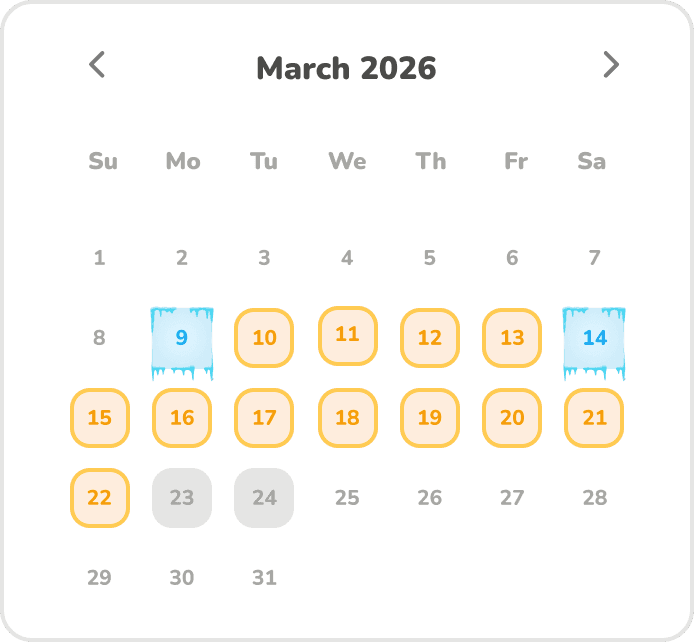
breaks in activity
breaks in activity
Missed days
Missed days
days the user showed up and practiced
days the user showed up and practiced
days where the streak was protected
days where the streak was protected
Active Days
Active Days
Freeze Days
Freeze Days
This visual clarity removes the need for interpretation, and users can immediately see:
Patterns in their behavior
Where they stayed consistent
Where they struggled
This visual clarity removes the need for interpretation, and users can immediately see:
Patterns in their behavior
Where they stayed consistent
Where they struggled
It avoids being overly punishing while still reinforcing habit-building. Instead of making users feel bad for missing a day, it: encourages them to keep going
It avoids being overly punishing while still reinforcing habit-building. Instead of making users feel bad for missing a day, it: encourages them to keep going
THE OUTCOME
THE OUTCOME
Together, these systems shift motivation from pressure to rhythm. Instead of relying on willpower, users are supported by:
small, guided actions
visible progress
and flexibility when they miss a day
This makes returning to the app feel easier, more natural, and more consistent over time.
Together, these systems shift motivation from pressure to rhythm. Instead of relying on willpower, users are supported by:
small, guided actions
visible progress
and flexibility when they miss a day
This makes returning to the app feel easier, more natural, and more consistent over time.





Other screens
Mistake Review: Turning Errors into Clarity
Not just a record of errors, but a space to understand and improve.
the shift 'behind the screens'
the shift 'behind the screens'
Working through this experience shifted my thinking from designing screens to designing decisions.
Initially, I focused on adding features and making the interface feel complete. But over time, I began questioning every element more critically — asking whether it truly supported the user’s learning or simply added noise.
Working through this experience shifted my thinking from designing screens to designing decisions.
Initially, I focused on adding features and making the interface feel complete. But over time, I began questioning every element more critically — asking whether it truly supported the user’s learning or simply added noise.
‘If this didn’t exist, would it actually impact the user’s learning?’
‘If this didn’t exist, would it actually impact the user’s learning?’
The moment I caught myself thinking
The moment I caught myself thinking
that’s when things changed.
that’s when things changed.
It made me realize that design isn’t about what feels right to me or looks good, but whether it genuinely helps the user in a meaningful way. That was the moment I understood how a product designer thinks it felt like I was finally moving in the right direction.
It made me realize that design isn’t about what feels right to me or looks good, but whether it genuinely helps the user in a meaningful way. That was the moment I understood how a product designer thinks it felt like I was finally moving in the right direction.
This shift led me to simplify and remove unnecessary elements — avoiding extra steps in mistake review, not overloading the progress section, and ensuring every interaction reduced friction.
I also realized how small decisions carry weight. Letting users resume instantly, structuring focused practice modes, and keeping progress simple weren’t just UI choices — they directly shaped user behavior and consistency.
This shift led me to simplify and remove unnecessary elements — avoiding extra steps in mistake review, not overloading the progress section, and ensuring every interaction reduced friction.
I also realized how small decisions carry weight. Letting users resume instantly, structuring focused practice modes, and keeping progress simple weren’t just UI choices — they directly shaped user behavior and consistency.
There were also moments where implementation challenges pushed me beyond design tools — whether it was creating custom interaction patterns like the ripple effect or figuring out layout behaviors. These experiences reinforced the importance of problem-solving independently rather than relying only on predefined solutions.
There were also moments where implementation challenges pushed me beyond design tools — whether it was creating custom interaction patterns like the ripple effect or figuring out layout behaviors. These experiences reinforced the importance of problem-solving independently rather than relying only on predefined solutions.
There were also moments where implementation challenges pushed me beyond design tools — whether it was creating custom interaction patterns like the ripple effect or figuring out layout behaviors. These experiences reinforced the importance of problem-solving independently rather than relying only on predefined solutions.
There were also moments where implementation challenges pushed me beyond design tools — whether it was creating custom interaction patterns like the ripple effect or figuring out layout behaviors. These experiences reinforced the importance of problem-solving independently rather than relying only on predefined solutions.